Choosing a laser cutting machine is one of the biggest capital decisions a fabrication business will make. It shapes what you can cut, how quickly you can turn work around, what your energy bills look like, and how competitive your quotes stay for years to come. For most UK manufacturers, the choice comes down to two technologies: fibre laser and CO₂ laser.
Both cut metal. Both have earned their place in workshops across the country. But they work in very different ways, and those differences have a real effect on running costs, maintenance, material range and long-term return. This guide explains how each system works and how they compare on the factors that actually influence a purchase, so you can match the technology to your production rather than to a headline cutting speed.
What Is a Fibre Laser?
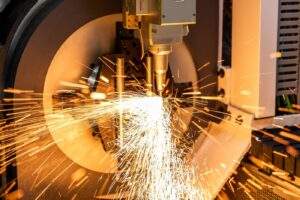
A fibre laser generates its beam inside a length of optical fibre doped with a rare-earth element, usually ytterbium. Laser diodes pump energy into the fibre, and the beam that emerges has a wavelength of around 1.06 microns. That beam travels to the cutting head through a flexible fibre-optic cable rather than a series of mirrors.
Two things follow from this design. First, the shorter wavelength is absorbed far more readily by metals, including reflective ones such as aluminium, brass and copper. Second, there is no open beam path to keep aligned and no laser gas needed to create the beam, which makes the machine simpler to run and to look after. These characteristics are why fibre has become the default choice for modern sheet metal cutting, and why ranges such as the ACCURL CNC fibre lasers now cover everything from thin decorative sheet through to heavy plate.
What Is a CO₂ Laser?
A CO₂ laser produces its beam by passing an electrical discharge through a sealed mixture of gases, primarily carbon dioxide. The resulting beam has a longer wavelength of 10.6 microns and is guided to the cutting head by a carefully aligned arrangement of mirrors.
CO₂ technology is the older of the two and dominated metal cutting for decades. It remains capable, particularly on thicker mild steel where it built its reputation for smooth cut edges, and it holds one advantage fibre cannot match: the longer wavelength is well absorbed by non-metals, so CO₂ can cut and engrave materials such as acrylic, wood, plastics and textiles. For pure metal work, however, its higher running costs and greater maintenance demands have seen it steadily give ground.
Fibre Laser vs CO₂ Laser: Key Differences
The two technologies diverge across almost every measure that matters on the shop floor. Here is how they compare point by point.
Laser Source
Fibre uses a solid-state source with the beam created in the fibre itself. It is compact, sealed and stable. CO₂ relies on a gas-filled resonator that consumes laser gas and needs periodic attention to stay in tune. The solid-state approach is the main reason fibre machines are cheaper and simpler to keep running.
Cutting Speed
On thin and medium-gauge sheet, fibre is dramatically faster, often two to three times quicker than a comparable CO₂ machine and sometimes more. That advantage is greatest on material up to around 6mm, which is exactly the range most fabricators spend their day cutting. On very thick plate the gap narrows, though high-power fibre sources have now moved ahead there too.
Accuracy
Both technologies are capable of tight tolerances. Fibre produces a smaller, more concentrated spot, which supports fine detail and clean piercing on thin material. For most sheet metal parts the accuracy of a well set-up fibre machine is more than sufficient, and repeatability across long production runs is excellent.
Operating Costs
This is where the difference becomes hard to ignore. Fibre converts far more of the electricity it draws into cutting power, so it does the same work for a fraction of the energy. It also avoids the cost of laser gas and the consumables associated with a mirror beam path. Over a year of production the saving is substantial.
Maintenance Requirements
A fibre machine has no mirrors to clean or align and no resonator gas to replenish. The source is sealed and the diodes are rated for very long service lives. CO₂ machines need regular optical maintenance, gas top-ups and more frequent servicing, all of which adds downtime and cost.
Energy Efficiency
Fibre lasers typically achieve wall-plug efficiency of around 30 to 45 percent, compared with roughly 10 to 15 percent for CO₂. Less of your power bill is lost as heat, which also reduces the load on chillers and extraction.
Machine Lifespan
The diode modules at the heart of a fibre source are commonly rated at around 100,000 hours, and the sealed design means fewer components degrade over time. CO₂ resonators can be rebuilt, but they demand more ongoing intervention to hold performance.
Automation Compatibility
Because fibre delivers its beam down a cable and runs with minimal supervision, it integrates neatly with automated loading and unloading, tube-cutting attachments and lights-out production. Fabricators looking to scale output without adding labour tend to build around fibre for this reason.
Which Materials Can Each Laser Cut?
Material range is often the deciding factor, so it is worth being specific.
- Mild steel: both cut it well. Fibre is faster on thin and mid-gauge, and modern high-power fibre also handles thick plate that was once CO₂ territory.
- Stainless steel: a strong area for fibre, especially with nitrogen assist gas for clean, oxide-free edges.
- Aluminium: fibre cuts it readily. Its reflectivity makes it difficult for CO₂.
- Brass and copper: highly reflective and problematic for CO₂. Fibre handles both thanks to its shorter wavelength.
- Galvanised steel: cut efficiently by fibre, with good edge quality.
- Non-metals such as acrylic, wood and plastics: this is CO₂ territory. Fibre is not suited to most organic materials because they do not absorb its wavelength well.
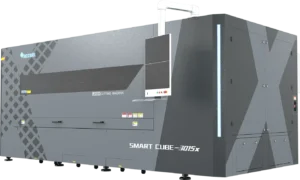
The short version is that if your work is metal, and particularly if it includes reflective metals, fibre covers more of your requirement. If you regularly cut non-metals, CO₂ still has a role. The ACCURL fibre range supplied by Axe & Status is built around metal fabrication, with flatbed, tube and compact cube configurations to suit different part types.
Fibre Laser vs CO₂ Laser Cutting Speed
Speed is not just about impressive numbers on a spec sheet, it is about how many parts leave the door each shift. On thin sheet a fibre laser engraver can move through material so quickly that the limiting factor becomes how fast parts can be loaded and removed rather than the cut itself. That is why automation and fibre are so often specified together.
For a business quoting competitively, faster cutting means more jobs per machine, shorter lead times and better use of skilled labour. Even where a CO₂ machine could produce the same part, it will usually take longer to do so, and that time carries a cost.
Running Costs Compared
Compared over their working lives, the running-cost gap is one of the strongest arguments for fibre. The main contributors are:
- Electricity consumption: fibre’s higher efficiency means a markedly lower draw for the same cutting power.
- Gas consumption: CO₂ needs laser gas to generate the beam. Fibre does not, though both use assist gases such as nitrogen or oxygen at the cutting head.
- Maintenance: fewer serviceable parts and no beam-path optics keep fibre maintenance low.
- Consumables: the sealed fibre source avoids many of the consumables a CO₂ machine gets through.
- Downtime: less servicing and fewer stoppages mean more productive hours.
Individually these look modest. Added together across a busy production year, they change the economics of the machine.
Which Laser Delivers Better Cutting Quality?
CO₂ earned a loyal following for the smooth edge it produces on thicker mild steel, and for years that was a genuine reason to choose it for heavy plate. The picture has changed. Modern high-power fibre sources, paired with the right assist gas and cutting parameters, now produce excellent edge quality across the full thickness range, including the reflective metals CO₂ struggles with at all.
For thin and medium material, fibre’s fine spot and clean piercing give it the edge on detailed work. For most fabricators the quality question is effectively settled in fibre’s favour, with CO₂ retaining an advantage only in specific applications.

Which Machine Is Easier to Maintain?
Maintenance is where the practical difference is felt week to week. A fibre laser has no mirrors to clean or realign, no resonator gas to manage and a sealed source designed to run for tens of thousands of hours. Routine care is largely about keeping the cutting head, its optics and the assist-gas system in good order.
A CO₂ machine asks for more. The mirror beam path needs cleaning and alignment, the resonator needs gas and servicing, and the greater complexity means more that can go wrong. For a business that measures success in uptime, this is a meaningful distinction. Whichever technology you run, a responsive service arrangement matters, which is why Axe & Status backs its machines with installation, training and ongoing maintenance rather than leaving customers to manage alone.
ROI: Which Machine Offers Better Long-Term Value?
Return on investment is where the individual advantages come together. A fibre laser tends to win on:
- Productivity: more parts per hour, especially on the thin and mid-gauge material most shops cut.
- Labour savings: high speeds and easy automation mean more output without more operators.
- Reduced maintenance: less servicing and fewer consumables lower the ongoing bill.
- Lower operating costs: better energy efficiency and no laser gas reduce cost per part.
- Return on investment: faster payback and stronger long-term value.
A machine is a long-term asset, and total cost of ownership matters more than the purchase price alone. When fabricators run the numbers over five to ten years, fibre usually comes out ahead for metal work by a clear margin.
When Does a CO₂ Laser Still Make Sense?
A balanced answer has to acknowledge where CO₂ still fits. It remains a sound choice if your work involves cutting or engraving non-metals such as acrylic, wood, foam or textiles, where its wavelength is genuinely better suited. It can also make sense if you already own a well-maintained CO₂ machine that is meeting demand, since there is no value in replacing equipment that still earns its keep. And there are specific processes and finishes where an established CO₂ setup continues to deliver.
For a business whose core work is metal fabrication, though, and especially one planning to grow or to cut reflective materials, these situations are the exception rather than the rule.
Why Most UK Fabricators Are Switching to Fibre Lasers
The move towards fibre across UK workshops is not driven by fashion, it is driven by economics and capability. The recurring reasons are:
- Faster production that improves lead times and throughput.
- Lower running costs that protect margins on every job.
- Greater efficiency in energy use and floor space.
- Automation compatibility that supports growth without proportional increases in labour.
- Higher precision on the detailed, reflective and mixed-material work modern customers demand.
Taken together, these turn a laser from a cost centre into a competitive advantage. It is the combination, rather than any single factor, that has made fibre the default for new investment.
Fibre Laser vs CO₂ Laser at a Glance
The table below summarises how the two technologies compare on the measures that most influence a purchase.
| Feature | Fibre Laser | CO₂ Laser |
| Cutting speed | ★★★★★ | ★★★ |
| Operating costs | Low | Higher |
| Energy efficiency | Excellent | Moderate |
| Maintenance | Low | Higher |
| Reflective metals | Excellent | Limited |
| Thin sheet metal | Excellent | Good |
| Thick materials | Excellent (power dependent) | Good |
| Automation compatibility | Excellent | Good |
| Long-term ROI | Excellent | Moderate |
Conclusion
Both fibre and CO₂ laser cutting have a place, and CO₂ is far from obsolete for the right materials. But for the metal fabrication work that occupies most UK workshops, fibre offers greater speed, lower operating costs, reduced maintenance and stronger long-term value. As high-power fibre sources continue to close the gap on thick plate while extending their lead everywhere else, the case for fibre only grows.
The right machine is the one matched to your materials, volumes and ambitions. Getting that decision right pays back every shift for years.
About Axe & Status
Axe & Status has supplied CNC machine tools and sheet metal machinery to UK manufacturers for over fifty years. As the exclusive UK partner for ACCURL, we offer a full range of CNC fibre laser cutting machines in flatbed, tube and cube configurations, backed by applications engineering, installation, operator training and responsive aftercare. Our team helps fabricators choose the right specification for their work and supports the machine throughout its life.
Thinking about your next laser cutting machine? Talk to the Axe & Status team about matching the right ACCURL fibre laser to your materials and production. We can assess your parts, arrange a machine demonstration and set out the installation, training and support that comes with it, so you invest with confidence. Get in touch to arrange a consultation or a visit to our showroom.